Canada (English)
 Colombia
 Caribbean and Puerto Rico
 Ecuador
 India
 Indonesia
 Ireland
 Malaysia
 Mexico
 Panama
 Peru
 Philippines
 Singapore
 South Africa
 Sri Lanka
 Thailand
 United Kingdom
 United States

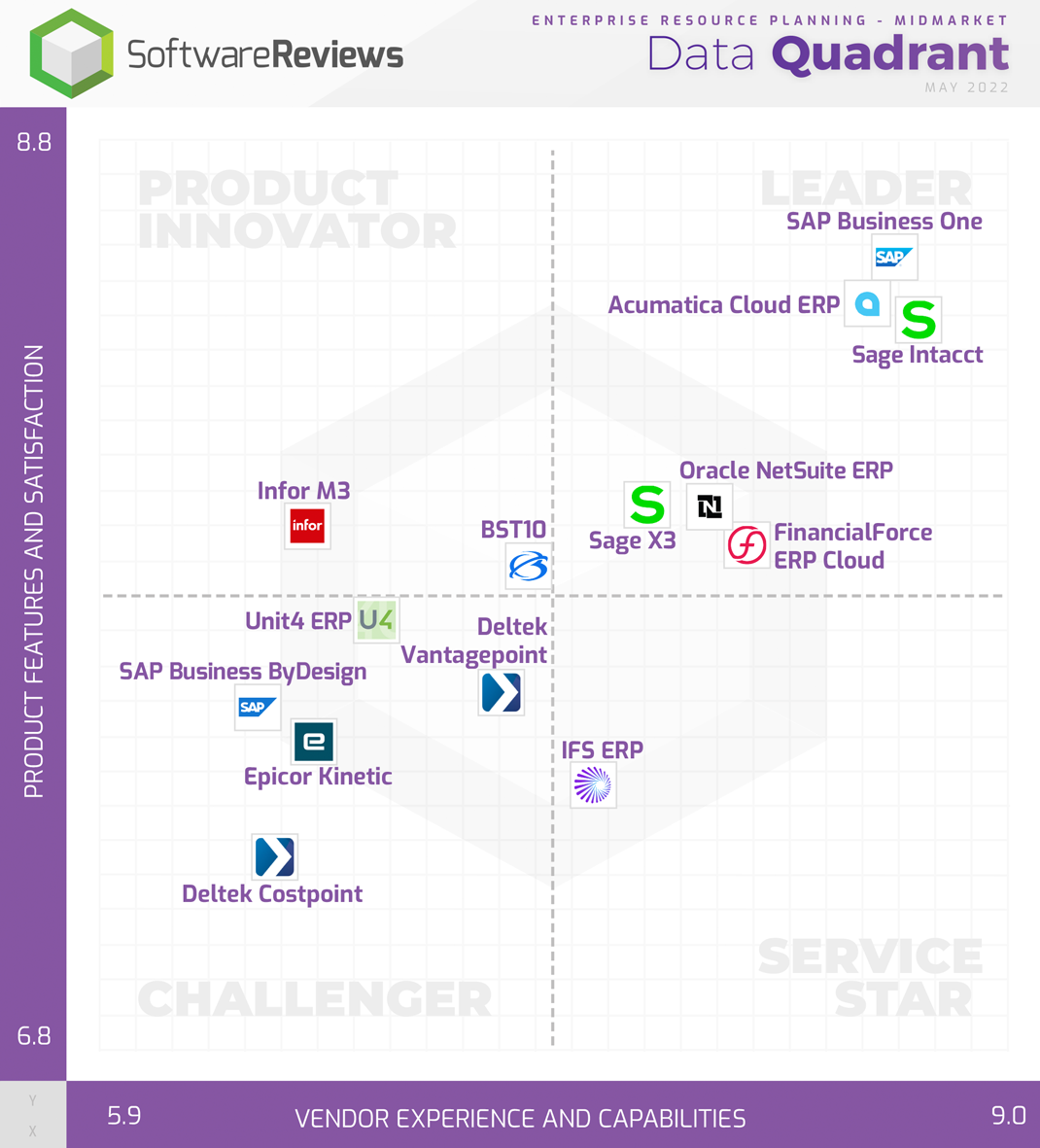
This report has been produced by SoftwareReviews on behalf of Acumatica based on select data from the May 2025 Data Quadrant Award.
For a full report please visit SoftwareReviews
REPORT GENERATED JULY 2025
Visión general
This page provides a high level summary of product performance within the Enterprise Resource Planning – Midmarket category, comparing some of our top value metrics. Products are ranked by a composite satisfaction score (Composite Score) that averages four different areas of evaluation: Net Emotional Footprint, Vendor Capabilities, Product Features, and Likeliness to Recommend. The Net Emotional Footprint Score measures user emotional response ratings of the vendor (e.g. trustworthy, respectful, fair). Use this data to get a sense of the field, and to see how the products you’re considering stack up.

Vendor Capability Summary
SoftwareReviews examines 11 core vendor capabilities common across all Software Vendors. These capabilities represent table-stakes expectations for any software vendor, and are critical to driving a strong, long-term relationship between a vendor and a customer. This page provides definitions of the 11 core vendor capabilities that have been measured.
Business Value Created:
The ability to bring value to the organization. Software needs to create value for employees, customers, partners, and, ultimately, shareholders. This data expresses user satisfaction – or lack thereof – with the product’s business value.
Breadth of Features:
The ability of the software to perform a wide variety of tasks. Users prefer feature-rich software that enables them to perform diverse series of tasks. This data expresses user satisfaction with the diversity of the product’s feature set.
Quality of Features:
The ability of the software to perform at or above industry standards. Feature quality is just as important as quantity. Use this data to determine if this product will do what you are purchasing it to do, easily, intuitively, reliably, and effectively.
Product Strategy and Rate of Improvement:
Purchasing software can be a significant commitment, so it is important to know if your vendor is serious about the need for constant improvement and deliberate strategic direction. Vendors who do not stay on top of emerging needs and trends will not enable you to meet your business goals. Use the data in this section to separate innovators from imposters.
Usability And Intuitiveness:
End user learning curves cost the organization money. Pay attention to your end users’ technical ability to determine how important UX is in your purchase. This data captures how quickly your users will be able to adopt and leverage the platform.
Vendor Support:
The ability to receive timely and sufficient support. The importance of vendor support will vary for each organization depending on internal capabilities, but there will always be issues that only the vendor can resolve. Use this data to identify which vendors will be there when you need them.
Ease of Data Integration:
The ability to seamlessly integrate the solution with your other applications. Use this data to determine whether the product will cause headaches or make data integration easy.
Ease of Administration:
Administrative interfaces shouldn’t be clunky or unintuitive. Use the data in this section to determine which vendors make administration easy so that your IT personnel can resolve issues and perform configurations efficiently and effectively.
Ease of Customization:
Out-of-the-box functionality often isn’t enough, especially for niche or industry- specific software, and the reason you’re buying rather than building is to save time and money in the first place. Don’t get bogged down in a difficult customization; use the data in this section to make sure you can easily achieve the functionality you need for your particular situation.
Availability and Quality of Training:
Effective and readily available training enables users to get the most out of the software you’ve chosen. Use this section to make sure your vendor’s training programs and materials measure up.
Ease of Implementation:
Choosing the right software is only the first step. Successfully implementing the new solution is necessary in order to realize its full value and promote end user adoption. Use the data in this section to determine which software is easy to implement, and which may jeopardize your goals by causing trouble in this stage.

Product Feature Summary
SoftwareReviews examines product features specific to the Enterprise Resource Planning – Midmarket software category. Features have been chosen based on market relevancy and typical use within the category. Use this data to compare against your primary use case and identify relative strengths and weaknesses across your shortlisted vendors.
Accounting and Financial Management:
Includes accounting and finance functions such as general ledger, accounts payable, and accounts receivable.
Analytics and Reporting:
Includes historical & real-time dashboard visualizations, detailed & summary reporting and easy data extraction for data analysis.
BI and Performance Management:
Includes all aspects of reporting and BI analytics, as well as planning and optimization.
Customer Relationship Management:
Includes sales order management functions such as quotes, contract, marketing, and automation.
Governance Risk and Compliance:
Includes governance, risk management, compliance, security management, controls and audit.
Human Capital Management:
Includes employee management functions such as recruiting, payroll, development and performance management.
Job and Project Management:
Includes all aspects of project planning management, costing and billing, resource management and controls, and product data management.
Procurement Management:
Includes purchasing and procurement management, as well as supplier management and optimization.
Service Management:
Includes all aspects of service management, service orders, requests, field service and contracts.
Supply Chain Management:
Includes all aspects of logistics, distribution, and inventory management, as well as warehouse and shipping, order promising, and asset management.
This page summarizes user satisfaction with a variety of product features. While strong and consistent performance across the feature set is preferable, you may be willing to tolerate low scores on features that don’t impact your primary use case or core objectives. Use this high-level data to help plan and structure your product evaluation.

Strategy & Innovation
Your vendor’s attitude toward innovation is important; if they aren’t at least keeping pace with market directions and trends, they certainly won’t be enabling you to get ahead. Use the data in this section to gauge whether your vendor appreciates the need to innovate and the extent to which they’ll support you to do the same.

Product Experience
Software needs to reliably enable your performance and productivity. Use the data in this section to see which vendors will propel you forward and which will be deadweight you’ll need to carry.

Negotiation & Contract
Negotiation doesn’t have to be adversarial. Both parties are always looking to get the best deal, but finding a vendor who will work with you rather than against makes it more likely you’ll both be happy with the results. Use the data in this section to determine which vendors will negotiate pleasantly and in good faith.

Conflict Resolution
Disagreements are inevitable, but knowing your vendor will handle them reasonably, fairly, and amiably can give you peace of mind. Use the data in this section to understand which vendors will behave professionally when conflict arises.

About SoftwareReviews
With practical advisory services and a data-driven approach, SoftwareReviews’ mission is to improve the B2B software experience for all software buyers and providers. Our pragmatic tools and detailed customer insights help software buyers maximize success with their technology decisions. We collect the most in-depth customer review data from both business and IT professionals to shorten the time to decision and action for software purchasers and improve overall buyer satisfaction.
Combining deep buyer knowledge and experience, SoftwareReviews’ go-to-market practice helps technology providers better understand customer needs and accelerates planning and execution of go-to-market and product strategy.
SoftwareReviews is a division of Info-Tech Research Group with over two decades of research-based IT advice and technology implementation.
SoftwareReviews Methodology
SoftwareReviews collects in-depth, first-party feedback from verified end users about their customer experience with their top enterprise software providers. Quantitative and qualitative feedback data is collected via SoftwareReviews’ proprietary online survey platform. The survey gathers over 130 data points on each product, allowing the end user to thoroughly evaluate their experiences over their full lifecycle using the software – from their selection experience through their purchase and service experience.
Every review is meticulously checked through a robust quality assurance process to ensure it is submitted by a real person with valid credentials for using the software.
End user experience and sentiment measures revealing product feature fit, perceived vendor capabilities, business value drivers, and the quality of the vendor relationship are accessible at both a high level roll up and a more detailed drill down.