Canada (English)
 Colombia
 Caribbean and Puerto Rico
 Ecuador
 India
 Indonesia
 Ireland
 Malaysia
 Mexico
 Panama
 Peru
 Philippines
 Singapore
 South Africa
 Sri Lanka
 Thailand
 United Kingdom
 United States

Mickey North Rizza, Group Vice President, Enterprise Software and Agents
The Digital AI World: The Cost of Doing Nothing and the Pressing Need to Move to Cloud ERP
Today’s digital AI world places clear emphasis on AI-enabled cloud ERP. IDC’s Future Enterprise Resiliency and Spending Survey (Waves 8 and 9, October and December 2025, total n = 1,897) found organizations are modernizing their enterprise applications in 2026 because of two critical outcomes they must achieve: 41.2% of organizations need to improve the cyber-resiliency of their core applications and 39.9% of organizations need to ensure their core applications are AI enabled. In addition, 28.6% of organizations noted they need to reduce the cost of core applications and 26.7% of organizations said they must move to the SaaS/cloud-based version of those applications. These organizations increasingly recognize that if they do not move to modern systems, including cloud and AI, they will be laggards in the digital AI world.
With this world comes a new threshold to compete, which means faster decision velocity, a greater need to scale quickly, and more agility and resiliency being required to navigate speed bumps. The costs are high for those who stand still or do nothing to transform their organization and move to modern technology. The business may be doomed to fail because of the loss of efficiency, competitiveness, and profitability. With the increase in the pace and speed of business brought on by cloud computing and dramatic new AI capabilities, the need for modern cloud ERP systems coupled with AI is enhanced greatly.
It is critical for today’s businesses to leverage digital technologies (e.g., SaaS, cloud systems, and extreme automation) and advancements (e.g., AI, ML, GenAI, and AI agents) to compete. In fact, more than half of organizations want AI embedded into their core workflows to ensure they move forward with innovation. By embracing speed and scale, a digitally transformed organization can move fast while growing its business to meet escalating demand. IDC’s April 2025 SaaS Path Survey found that there were a number of reasons organizations moved to new ERP systems.
At a Glance
Moving to a cloud ERP system coupled with AI enhances decision velocity, scalability, agility, and resilience in the digital AI world.
Key Stats
- 41% of organizations need to improve cyber-resiliency of their core applications.
- 39.9% of organizations need to ensure their core applications are AI enabled.
- 28.6% of organizations need to reduce the costs of their core applications.
- 26.7% of organizations must move to a SaaS/cloud ERP system.
First and foremost, 36% of organizations are advancing their digital transformation strategies — improving speed, scalability, and agility. Achieving meaningful growth and scale requires strategies that enable even faster decision-making across all data elements efficiently. This increased emphasis on growth and success necessitates the right technology underpinning all operations. In that technology’s absence, the organization will be left vulnerable in terms of revenue, growth, and scale. In addition, 34% of organizations are looking for better configurability with their new ERP system, while 33.3% need better embedded AI workflows and intelligence. IDC found midmarket organizations are more rapidly investing in finance areas to capture the value more quickly across their entire business. Configurability makes it much easier to bring together the data and provide one holistic view across all the business entities of an organization, ensuring the health of the business at all times. And when it comes to AI, these same organizations need to automate repetitive tasks while generating insights that enhance their velocity in decision-making. Together, these pieces help businesses reimagine outcomes, enabling growth and scalability faster than ever before.
Organizations embracing a modern cloud ERP and AI mindset are best positioned to utilize digital transformation to embrace speed and scale, meet demand, compete at a new level, and thrive in the AI world.

Consider the cost of doing nothing to your technology underpinning
Regardless of the outcomes and potential benefits organizations can achieve from a modern cloud ERP system, many are still stuck using legacy applications or spreadsheets to run their businesses. With no real-time information or continuously updated data, there are tremendous gaps in efficiency, resulting in slower decision velocity, which could be a deal breaker in terms of revenue recognition or profitability planning. The core downside of doing nothing is the cost that will only increase over time. Organizations have told IDC that there are many factors that contribute to the cost of doing nothing and not moving to a modern cloud ERP system. These include:
- Higher run costs and technical debt: Legacy ERP systems are expensive to maintain and customize, with brittle integrations and security gaps that compound over time. In addition, spreadsheets suffer from continuous saves, version control problems, and little transparency.
- Lower productivity and slower decisions: Manual/semi-manual workflows persist, keeping cycle times long and decision velocity low; most organizations expect agentic AI in an ERP solution to eliminate these workflows. In fact, IDC finds 80% of organizations in IDC’s 2026 SaaS and Agent Path significantly prioritize eliminating manual and semi-manual workflows with agents.
- Reduced agility and visibility: Legacy environments and spreadsheets limit scalability and real-time insights, delaying responses to disruptions and hampering operational KPIs, like inventory accuracy and on-time delivery.
- Increased opportunity cost on AI-driven gains: As ERP publishers embed AI assistants and agents, organizations that delay modernization forgo automation, predictive insights, and faster time to value that peers are adopting now. This has an immediate impact on the organization’s ability to respond quickly and scale as needed, and it will ultimately impact the competitiveness of the organization.
- Higher risk and compliance exposure: Older architectures and data fragmentation increase vulnerabilities and make explainability and auditability harder to achieve at scale.
Organizations using legacy ERP systems and spreadsheets need to expect higher total cost of ownership over time as well as increased vulnerabilities in scalability and risk. Modernization by implementing an AI-enabled cloud ERP solution will bring greater competitive capabilities and may increase market share through standardization in the cloud and harvesting AI-enabled efficiency and speed. IDC’s 2025 SaaS Path Survey found 44% of organizations believe GenAI is highly important and critical for their applications. In the absence of these capabilities, IDC finds delays in responses that translate into extra time spent on reconciliations, error removal and handling, exception management, and long cycle times with lower KPIs. However, most organizations using modern cloud ERP coupled with AI find cost reductions, significant process improvements, and greater visibility.
Beneficios
As midmarket companies consider moving to a modern cloud ERP system, accounting for the potential outcomes enables them to quickly see the differences between their current circumstances and their desired, post-implementation state. The cloud ERP system standardizes many workflows across operations while reshaping business models and redefining the work as the organization progresses on its AI journey. In addition, ERP modernization allows businesses to establish a new working model that is agile and scalable, reinforced with AI. As stated by respondents to the IDC’s April 2025 SaaS Path Survey, moving to the cloud brings flexibility, efficiency, and innovation opportunities, including the following:
- 37% — AI supported better, faster decision-making
- 37% — digital enablement
- 36% — digital enhancement with business processes that are seamless and digital
- 32% — improved customer experience
- 31% — enhanced workflows through embedded AI
- 31% — improved employee experience
- 31% — improved visibility
- 30% — improved agility increasing the ability to think, understand, and move quickly
- 29% — reduced manual processing
- 27% — optimized processes
- 26% — reduced costs
- 25% — enabled industry-specific attributes
- 25% — encouraged innovation
Tendencias
The IDC’s April 2025 SaaS Path Survey asked organizations about their vision of the perfect ERP system and found it included the key attributes that appear in Figure 2.
Businesses want to quickly integrate technology and use it immediately. Updates must be smooth and easy so that the
business can continue without interruptions. With more speed and scalability, organizations are more agile in responding
to and navigating ongoing business changes.
Organizations investing in modern and advanced ERP technologies uncover substantial benefits. IDC’s April 2025 SaaS
Path Survey discovered that the top impacts of moving to a new ERP system include:
» Improved visibility
» Reduced costs
» Digital enablement and enhancement
» An improved employee and customer experience
» The ability to use AI to monitor, provide insights, and predict
» Optimized processes
» New levels of automation that have reduced or eliminated manual processes

Acerca de Acumatica
Acumatica is an all-in-one cloud ERP solution purpose built for businesses in the construction, distribution,
manufacturing, and professional services managementindustries. The system was specifically designed for business
usersto quickly adopt, use, and run the business upon implementation while innovating continuously to add even more
functionality and capabilities.
Acumatica’s intuitive Cloud ERP solution with AI automation simplifies workflows because it handles routine processes,
identifies anomalies, and delivers actionable insights,so the organization can operate more efficiently and focus on
driving strategic growth. In addition, Acumatica’s Cloud ERP platform provides secure, anytime, anywhere access with no
hidden costs and unlimited users, enabling every business to scale as needed.
Desafíos
Not all organizations are ready to invest in a modern cloud AI-enabled ERP system. It may not yet be on their roadmap,
and they may not understand how it will immediately enhance their business. In addition, not all modern cloud ERP
systems have deployed AI capabilities,such as AI assistants and AI agents; however, they may have intuitive capabilities
with AI-powered automation to simplify workflows, identify anomalies, and bring forward actionable insights that make
running a business easier overall.
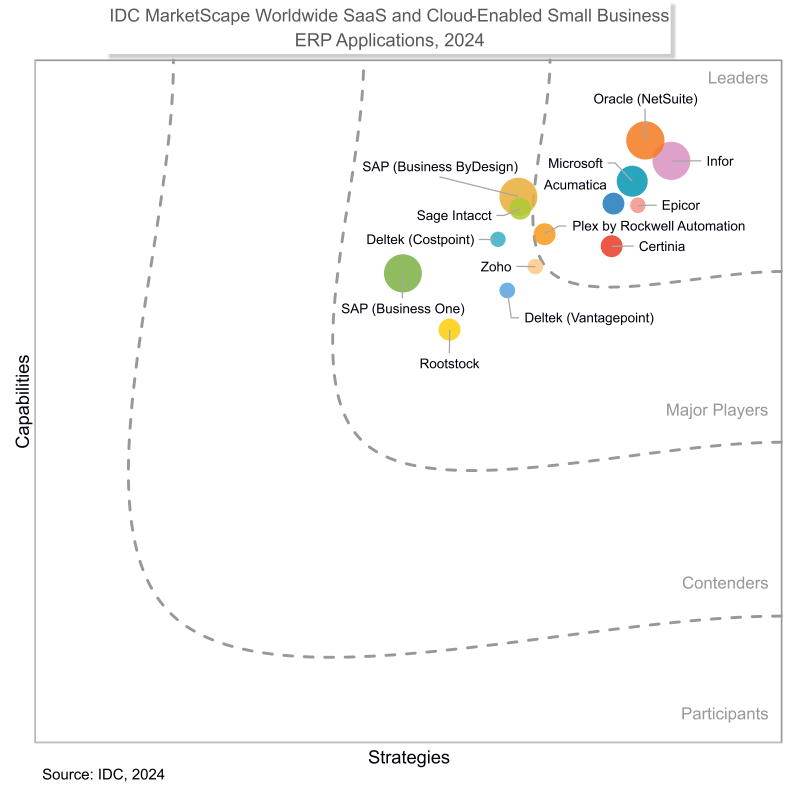
Before choosing to move to an AI-enabled cloud ERP system, businesses must understand where their vendor is on the
AI journey. They should review the vendor’s AI roadmap and understand how the AI capabilities that system provides
can be practically applied to their unique business context. They should also compare the vendor’s platform, the
customer value it provides, and how trustworthy it is against other software providers. The vendors that have won the
most customer trust and are focused on scaling their cloud ERP systems with AI to transformtheir clients’ business
operating models are critical drivers of the digital AI world.
Conclusión
As organizations recognize the need to move to a modern cloud ERP system coupled with AI, their technology transforms and helps them advance in the digital AI world. These modern, AI-enabled cloud ERP systems can manage vast amounts of data in real time, enhancing an organization’s performance capabilities. These systems are also leading the way to more autonomous business processes, evolving the nature of information from intelligence to insights to immediate, decisive actions. These advances, when properly leveraged, give organizations a competitive advantage in speed, scale, agility, and resiliency — transforming them into truly AI-underpinned businesses. This new identity means they can maneuver faster, better, and with greater success than their competitors. With robust AI underpinning, the cost of doing nothing and the benefits of modernization become the ROI of creating new business value and a new operating model to thrive in the digital AI world.
“AI makes it easier to interact, get at the data, and improves our decisioning.”
Message from the Sponsor
Sticking with legacy, on-premises systems feels safe but carries hidden costs. IDC’s Spotlight Paper shows clearly how outdated software creates data silos, slows decision-making, and exposes businesses to mounting security risks. Modern, cloud-based ERP solutions with embedded AI change the equation—delivering real-time insights, automated workflows, and the scalability to grow without adding overhead. Instead of piecing together reports, teams act on accurate, connected data the moment they need it.
The shift is already happening. IDC’s SaaS Path Survey (April 2025) found 44% of organizations believe GenAI is highly important and critical for their applications, up sharply from previous studies. Inaction means falling behind more agile competitors, who are turning data into smarter, quicker decisions. The question is not whether to modernize, but how soon to start.
To find out how you can reap the benefits of modern cloud-based ERP combined with AI-enabled capabilities, please visit Acumatica.com.
Publication Notices
The content in this paper was adapted from existing IDC research published on www.idc.com.
IDC Custom Solutions produced this publication. The opinion, analysis, and research results presented herein are drawn from more detailed research and analysis that IDC independently conducted and published, unless specific vendor sponsorship is noted. IDC Custom Solutions makes IDC content available in a wide range of formats for distribution by various companies. This IDC material is licensed for external use, and in no way does the use or publication of IDC research indicate IDC’s endorsement of the sponsor’s or licensee’s products or strategies.
International Data Corporation (IDC) is the premier global provider of market intelligence, advisory services, and events for the information technology, telecommunications, and consumer technology markets. With more than 1,300 analysts worldwide, IDC offers global, regional, and local expertise on technology and industry opportunities and trends in over 110 countries. IDC’s analysis and insight help IT professionals, business executives, and the investment community make fact-based technology decisions and achieve their key business objectives.
©2026 IDC. Reproduction is forbidden unless authorized. All rights reserved. CCPA