
 Canada (English)
 Colombia
 Caribbean and Puerto Rico
 Ecuador
 India
India
 Indonesia
 Ireland
 Malaysia
 Mexico
 Panama
 Peru
Peru
 Philippines
 Singapore
 South Africa
 Sri Lanka
 Thailand
 United Kingdom
 United States
 AcumatiCares


¿Qué es la contabilidad de proyectos y en qué se diferencia de la contabilidad general?
The two are complementary rather than competing approaches. Project accounting gives managers detailed information for controlling individual projects, while general accounting provides the complete financial record for the business. Project transactions should ultimately post to and reconcile with the general ledger.
Companywide financial statements may show that a business earned a profit without revealing which projects produced that result. A construction company managing several contracts, a consulting firm serving fixed-fee and retainer clients, or a software company delivering milestone-based engagements needs financial visibility at the project level.
Project accounting provides that visibility by connecting budgets, costs, time, billing, revenue, and margins to individual projects. This article explains how it differs from general accounting, how the project accounting process works, which reports matter, and when dedicated software may be necessary.
Principales conclusiones
- La contabilidad de proyectos realiza un seguimiento de los costes, los presupuestos, la facturación, los ingresos y la rentabilidad a nivel de proyecto, en lugar de a nivel de toda la empresa.
- La contabilidad general y la contabilidad de proyectos tienen fines distintos y se dirigen a usuarios diferentes; ambas deberían conciliarse entre sí, en lugar de funcionar de forma independiente.
- Los responsables financieros se benefician del seguimiento de la contabilidad de los proyectos a lo largo de todo su ciclo de vida, y no solo al cierre del ejercicio.
- El reconocimiento de ingresos en las empresas que operan por proyectos suele diferir del momento de la facturación y requiere una cuidadosa adaptación a las condiciones del contrato y a las normas contables.
- Las empresas en crecimiento deberían evaluar si sus herramientas actuales permiten gestionar la complejidad de los proyectos, y no solo tareas básicas como la facturación o el seguimiento de tareas.
- Los sistemas ERP que integran los datos financieros de los proyectos con los datos operativos ofrecen a los equipos financieros, a los gestores de proyectos y a los directivos una visión compartida y en tiempo real del rendimiento de los proyectos.
| Comparison Area | Contabilidad general | Contabilidad de proyectos |
|---|---|---|
|
Enfoque principal |
Financial performance and position of the entire organization | Financial performance of an individual project, job, or contract |
|
Organizational Unit |
Company, entity, department, account, or reporting segment | Project, task, phase, cost code, contract, or deliverable |
|
Primary Purpose |
Financial reporting, controls, compliance, and companywide decision-making | Budget control, cost management, billing, forecasting, and project profitability |
|
Financial Records |
General ledger, journals, subledgers, and financial statements | Project budgets, costs, commitments, time, expenses, billing, and revenue |
|
Reporting Cadence |
Recorded continuously and reported through accounting periods | Monitored throughout the project lifecycle and at reporting periods |
|
Common Reports |
Income statement, balance sheet, cash flow statement, and trial balance | Budget versus actuals, project P&L, WIP, billing status, and forecast-to-complete |
|
Usuarios principales |
Finance teams, executives, managers, auditors, lenders, and other stakeholders | Project managers, finance teams, operations leaders, and executives |
|
Decisions Supported |
Overall financial performance, liquidity, compliance, and resource allocation | Project pricing, staffing, cost control, billing, change orders, and margin management |
|
Relationship to the General Ledger |
Provides the organization’s complete financial record | Supplies project-level detail that should post to and reconcile with the general ledger |
¿Qué es la contabilidad de proyectos en las finanzas empresariales?
Project accounting is the process of recording, monitoring, and reporting the financial activity associated with individual projects, jobs, or contracts. It gives finance and project teams a detailed view of how each project is performing against its budget, billing plan, contractual requirements, and expected margin.
At its core, project accounting organizes the following around each project, rather than across the business as a whole:
- Presupuestos de los proyectos, costes directos y costes indirectos
- Direct and indirect costs
- Mano de obra, materiales y gastos
- Purchase commitments and change orders
- Tiempo facturable, facturación e ingresos
- Margen por proyecto
- Customer billing and collections
- Work in progress
- Reconocimiento de ingresos
- Forecast-to-complete and expected profitability
Project accounting is especially important in construction, engineering, professional services, software, field service, and other industries in which costs and revenue vary substantially by project.
¿Qué debe saber un profesional de las finanzas sobre la contabilidad de proyectos?
Project accounting gives finance professionals a clearer view of which projects are profitable, over budget, underbilled, or at risk, enabling more informed decisions throughout the project lifecycle rather than after the fact. Finance professionals rely on variance analysis, budget versus actuals reporting, work-in-progress (WIP) tracking, and project-specific profit and loss (P&L) statements to assess individual project health. Project accounting supports internal decision-making, including resource allocation, contract negotiations, and margin management.
How Does the Project Accounting Process Work?
The project accounting process begins when a project is established and continues through financial closeout. Although the details vary by industry, contract, and accounting policy, most organizations follow these seven stages.
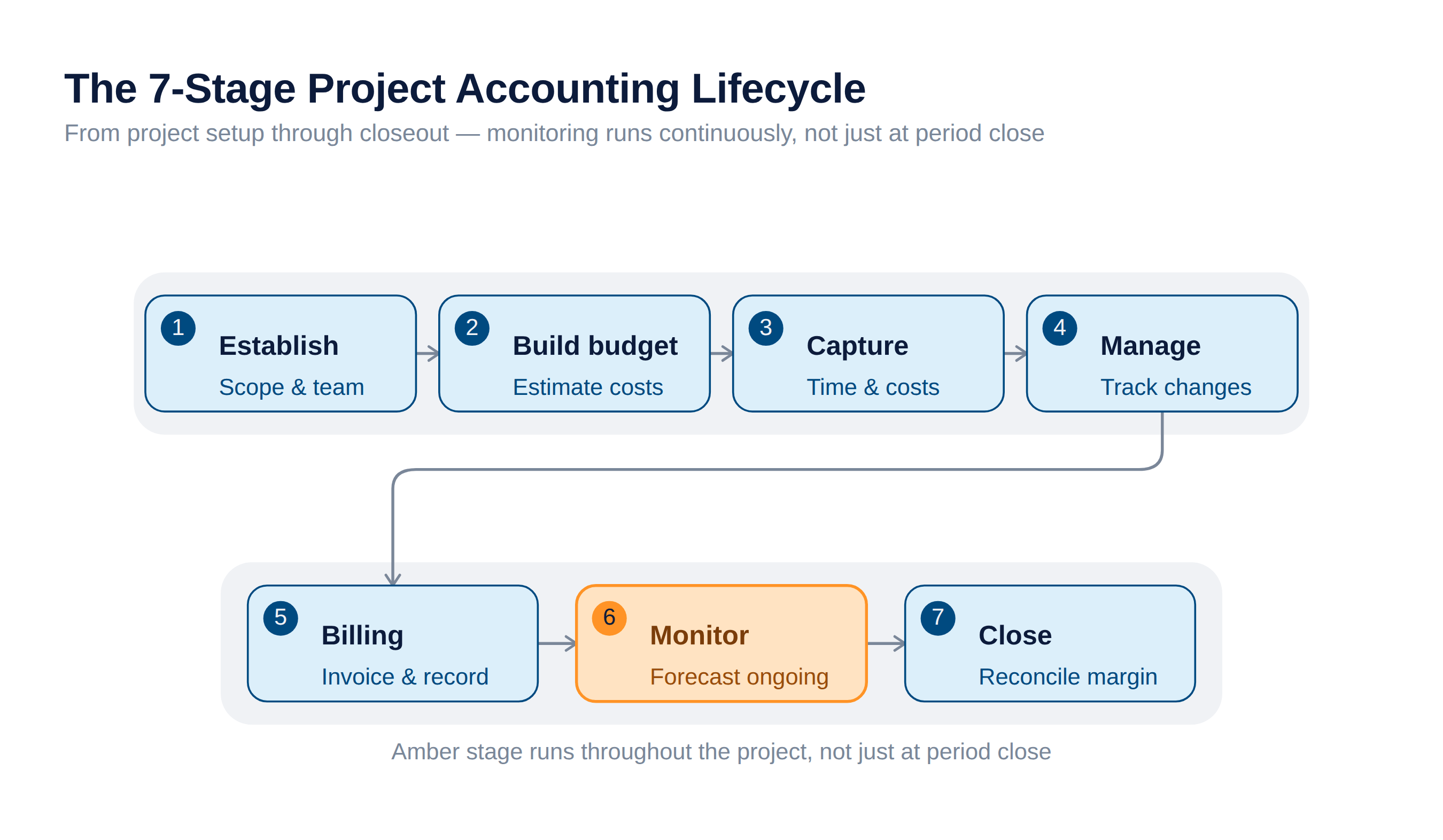
- Establish the project structure. Create the project record and define its customer, contract, manager, dates, tasks, phases, cost codes, billing rules, and financial reporting structure.
- Build and approve the budget. Estimate revenue, labor, materials, services, overhead, equipment, and other costs. Establish the original budget and define how revisions will be approved and recorded.
- Capture project transactions. Assign time, expenses, purchases, materials, subcontractor costs, and other transactions to the correct project, task, and cost category.
- Manage commitments and changes. Track purchase commitments, subcontract agreements, change orders, budget revisions, and other events that can affect the project’s expected cost or revenue.
- Bill the customer and recognize revenue. Generate invoices according to the contract’s billing method and recognize revenue according to the organization’s accounting policies and applicable standards. Billing and revenue recognition may occur at different times.
- Monitor performance and update forecasts. Compare budgets with actual and committed costs, review unbilled activity, estimate the remaining cost to complete, and update expected revenue, profit, and margin.
- Close and evaluate the project. Complete final billing, resolve outstanding commitments, reconcile project records with the general ledger, calculate final profitability, and document lessons for future estimates and projects.
What Is an Example of Project Accounting?
Consider a professional services firm delivering a fixed-fee implementation project with a contract value of $500,000 and an original cost budget of $400,000. During the project, the company records employee time, contractor invoices, travel expenses, customer billing, and approved changes against the project.
If actual costs reach $240,000, committed costs total $60,000, and the project team estimates another $120,000 will be required to finish the work, the forecasted final cost is $420,000. Unless contract revenue changes, the project’s expected profit would be $80,000 and its expected margin would be 16%.
General accounting will eventually reflect the project’s transactions in the companywide financial statements. Project accounting provides the detail needed to identify the expected $20,000 cost overrun while the project is still underway.
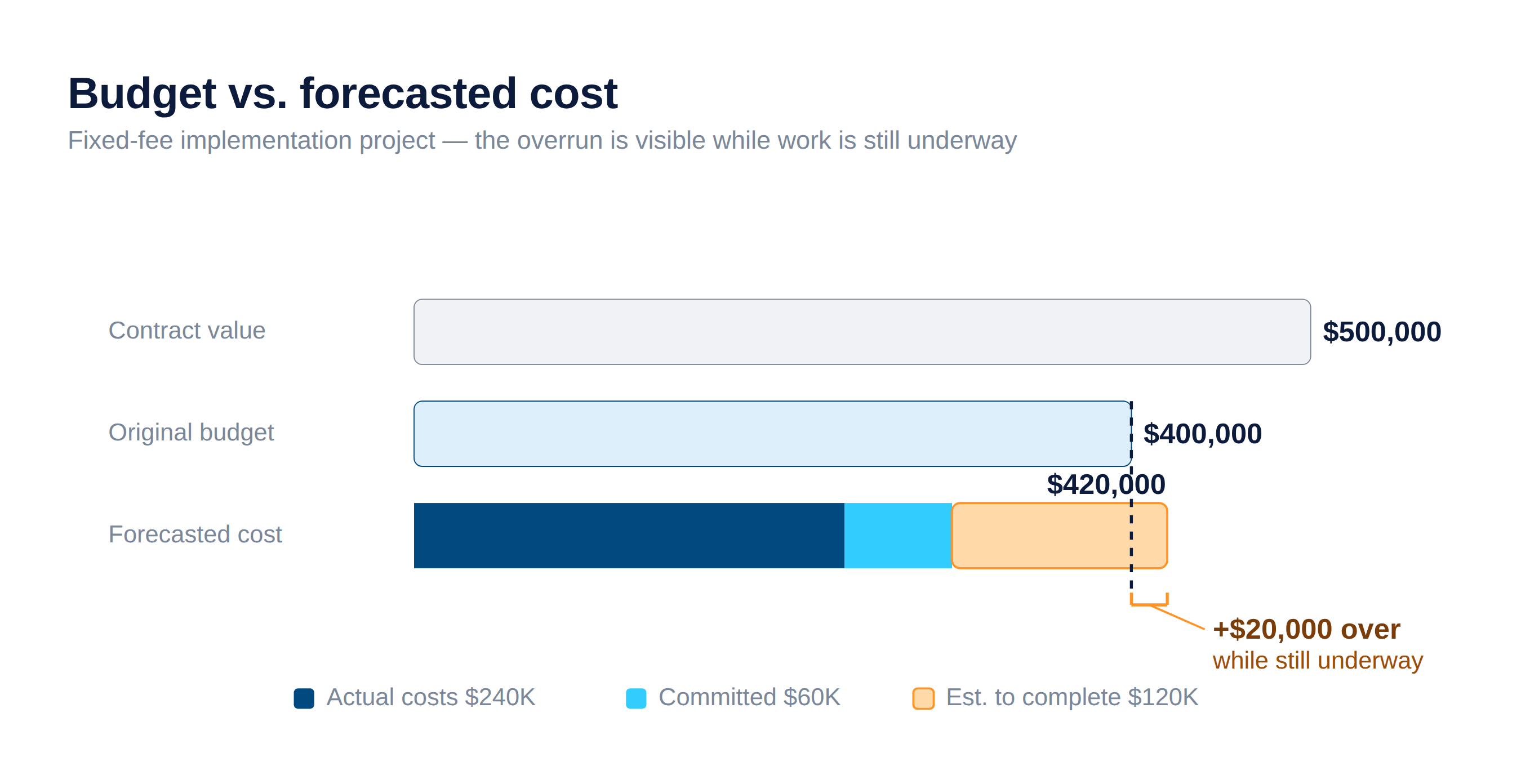
This simplified example illustrates project forecasting, not revenue recognition. Actual accounting treatment depends on the contract, accounting policies, and applicable standards.
En qué se diferencia la contabilidad de proyectos de la contabilidad general
General accounting reports the financial health of the overall business and captures financial activity at period close. Project accounting reports the financial health of each individual project and is typically monitored continuously, so issues with cost overruns or billing gaps surface while there is still time to act. Understanding this distinction helps organizations design the right reporting structure for their needs.
General accounting organizes financial data around the general ledger, accounts, departments, and reporting periods, producing statements such as the income statement, balance sheet, and cash flow statement. Project accounting organizes financial activity around project budgets, tasks, phases, contracts, and deliverables, producing reports that reflect the performance of a single engagement from start to finish.
Los usuarios, el momento en que se toman las decisiones y los fines que las motivan también varían. La contabilidad general está dirigida a directivos, auditores y partes interesadas externas que necesitan datos sobre el rendimiento de toda la empresa, mientras que la contabilidad de proyectos está dirigida a jefes de proyecto, equipos financieros y responsables de operaciones que necesitan actuar en tiempo real en función de indicadores financieros específicos de cada proyecto.
Un aspecto fundamental que conviene destacar es que la contabilidad de proyectos debe conciliarse con el libro mayor, en lugar de funcionar como un proceso aislado en una hoja de cálculo. Ambas funciones deben complementarse entre sí, de modo que la contabilidad de proyectos alimente el libro mayor y proporcione a los equipos financieros tanto información a nivel de proyecto como integridad financiera a escala de toda la empresa. Cuando los datos de los proyectos se almacenan fuera del sistema financiero principal, las discrepancias en la conciliación, las inconsistencias en los informes y los errores de facturación resultan más difíciles de detectar y corregir.
Contabilidad de proyectos frente a contabilidad general
| Contabilidad general | Contabilidad de proyectos | |
|---|---|---|
|
Ámbito de aplicación |
En toda la empresa | Proyectos individuales |
|
Cronometraje |
Informes de fin de período | De forma continua, a lo largo de todo el ciclo de vida del proyecto |
|
Informes |
Cuenta de resultados, balance, estado de flujos de efectivo | Presupuesto frente a resultados reales, cuenta de resultados del proyecto, trabajo en curso, estado de facturación |
|
Usuarios principales |
Directivos, auditores, partes interesadas externas | Responsables de proyectos, equipos financieros, responsables de operaciones |
|
Objetivo de la decisión |
Resultados empresariales y cumplimiento normativo | Rentabilidad de los proyectos, precisión en la facturación, gestión de márgenes |
¿Qué informes son los más importantes a la hora de tomar decisiones a nivel de proyecto?
Los informes de contabilidad de proyectos más útiles son aquellos que proporcionan a los responsables la información que necesitan para tomar decisiones operativas concretas, como, por ejemplo, si es necesario ajustar la plantilla, aprobar una orden de modificación, revisar una previsión o analizar la rentabilidad de un contrato.
Los informes principales suelen incluir:
| Project Accounting Report | Qué muestra | Decision It Supports |
|---|---|---|
|
Budget Versus Actuals |
Differences between planned and recorded costs or revenue | Determine where corrective action is needed |
|
Project Profit and Loss |
Revenue, costs, profit, and margin for a project | Evaluate financial performance |
|
Committed-Cost Report |
Purchase orders, subcontracts, and other costs not yet posted as actuals | Estimate future spending and cash requirements |
|
Forecast-to-Complete |
Expected remaining costs and forecasted final results | Identify potential overruns before project completion |
|
Unbilled Time and Expenses |
Billable activity that has not yet been invoiced | Prevent missed or delayed billing |
|
Work-in-Progress Report |
Project activity that may require billing or accounting treatment | Support period-end review and financial reporting |
|
Billing-Status Report |
Amounts billed, unbilled, collected, or outstanding | Monitor billing and customer payment activity |
|
Revenue-Recognition Schedule |
Revenue recognized and remaining under the applicable policy | Align financial reporting with contract performance |
|
Project Margin Report |
Current and forecasted profitability | Support pricing, staffing, and portfolio decisions |
The reports that matter most depend on billing models. A time-and-materials project requires close attention to unbilled hours and expenses, while a fixed-price contract demands careful monitoring of committed costs against the project budget to protect margin. Cost-plus, progress billing, and milestone-based billing models each produce different reporting needs, and finance teams benefit from configuring project reports to reflect how each contract is structured. The goal is to have a clear financial picture that helps project leaders make faster, better-informed decisions.
Is Project Accounting the Same as Job Costing?
Project accounting and job costing are related, but they are not identical.
Job costing assigns labor, materials, overhead, and other costs to a specific job so the business can determine what the job costs.
Project accounting has a broader scope. In addition to job costs, it may include budgets, commitments, customer billing, revenue recognition, work in progress, cash flow, forecasting, and project profitability. Job costing can therefore be considered one component of a complete project accounting process.
¿Cuándo debería una empresa mejorar sus procesos de contabilidad de proyectos?
Una empresa debería reforzar sus procesos de contabilidad de proyectos cuando la falta de visibilidad del margen, la facturación manual, el seguimiento mediante hojas de cálculo o una asignación de costes inconsistente estén afectando a su capacidad para gestionar la rentabilidad de los proyectos con confianza.
A company may need to strengthen its project accounting processes when:
- Project overruns are discovered only after work is completed.
- Managers cannot see current project profit or margin.
- Time and expenses are recorded late or assigned to the wrong projects.
- Billing requires significant spreadsheet preparation.
- Billable time or expenses are regularly missed.
- Project budgets and forecasts are maintained outside the accounting system.
- Purchase commitments are excluded from project cost reports.
- Change orders are not reflected promptly in budgets or billing.
- Project reports do not reconcile with the general ledger.
- Finance spends substantial time consolidating data from disconnected systems.
- Different teams report different results for the same project.
- Multi-entity or multi-currency projects require extensive manual work.
For growing small and mid-market organizations, the triggers are often structural: more entities, more projects, more complex contracts, more remote teams, and more stakeholders who need timely project data that their current systems cannot produce reliably. This is especially relevant for project-driven firms managing distributed teams, multi-location operations, or cross-border reporting needs, where inconsistencies in cost allocation or revenue recognition can compound across entities. Small variances in labor, materials, or subcontractor costs can materially affect profitability on a project with a fixed contract price, making the case for tighter project-level controls stronger as contract complexity grows.
¿Cómo pueden los equipos financieros reducir el trabajo manual relacionado con la contabilidad de proyectos?
Finance teams can reduce manual project accounting work by connecting time entry, expenses, purchasing, inventory, commitments, billing, project budgets, and financial reporting. Transactions should be assigned to the correct project when they are created rather than categorized later through spreadsheets.
Automation can streamline recurring activities such as importing time, routing expenses for approval, updating committed costs, preparing invoices, posting project transactions, and refreshing reports. Exceptions should be routed to the appropriate finance or project owner for review.
Automation does not replace accounting judgment or financial controls. Cost allocation, revenue recognition, contract interpretation, forecast changes, and period-end adjustments still require appropriate review and approval.
Por qué el reconocimiento de ingresos es fundamental en la contabilidad de proyectos
El reconocimiento de ingresos en la contabilidad de proyectos se refiere al principio de reconocer los ingresos en el momento en que se devengan, lo que puede diferir del momento en que se emiten las facturas o en que se cobra el importe, lo que lo convierte en uno de los aspectos más trascendentales y técnicamente exigentes de las finanzas de proyectos.
En el caso de las empresas que operan por proyectos, puede ser necesario reconocer los ingresos en función de:
- Hitos o porcentaje de finalización.
- Tareas completadas.
- Condiciones específicas del contrato.
Acumatica, un proveedor líder de ERP en la nube, ha publicado un artículo sobre el reconocimiento de ingresos en la contabilidad de proyectos en el que se explica que el método del porcentaje de finalización y el método del contrato completado son dos enfoques habituales (que ahora se reflejan en el marco de «a lo largo del tiempo/en un momento dado» de la norma ASC 606), y que el método adecuado depende de la naturaleza del proyecto y de las normas contables aplicables. La facturación y el reconocimiento de ingresos están relacionados, pero no siempre constituyen el mismo hecho. Una empresa puede facturar a un cliente un pago por adelantado y reconocer los ingresos de forma incremental a medida que se realiza el trabajo, o bien puede completar el trabajo antes de emitir ninguna factura.
Los requisitos para el reconocimiento de ingresos pueden variar en función del contrato, la jurisdicción, la norma contable y el modelo de negocio, por lo que es importante contar con conocimientos especializados en finanzas y contabilidad a la hora de diseñar las políticas de reconocimiento. El reconocimiento de ingresos, la contabilidad de contratos, la asignación de costes y las prácticas de presentación de información deben adaptarse siempre a las políticas contables específicas de la empresa, a sus controles internos y a los requisitos del sector y fiscales, y deben revisarse con profesionales cualificados en contabilidad, auditoría, fiscalidad y cumplimiento normativo, especialmente en entornos regulados, con múltiples entidades, transfronterizos o con contratos complejos.
¿Qué características son las más importantes en un software de contabilidad de proyectos?
Las funciones más importantes de un software de contabilidad de proyectos van mucho más allá de la simple facturación o el seguimiento de tareas. Deben abarcar todo el ciclo de vida financiero de un proyecto, desde la elaboración del presupuesto hasta la facturación final y el reconocimiento de ingresos.
Una lista práctica de aspectos a tener en cuenta para las empresas en crecimiento incluye:
| Capability | Qué hay que evaluar | Por qué es importante |
|---|---|---|
|
Project Structure |
Projects, tasks, phases, cost codes, contracts, and templates | Creates consistent financial tracking |
|
Gestión presupuestaria |
Original budgets, revisions, approvals, and version history | Preserves budget accountability |
|
Cost Capture |
Labor, expenses, materials, equipment, services, and overhead | Provides a complete view of project cost |
|
Compromisos |
Purchase orders, subcontracts, and expected costs | Improves forecasts before invoices are received |
|
Facturación |
Time-and-materials, fixed-price, milestone, cost-plus, and progress billing | Supports different contract models |
|
Gestión de ingresos |
Revenue schedules and support for applicable recognition policies | Helps align project activity and financial reporting |
|
Gestión de cambios |
Change requests, approvals, budgets, costs, and billing | Shows the financial effect of scope changes |
|
Project Reporting |
Budget versus actuals, WIP, margin, billing status, and forecast-to-complete | Supports timely project decisions |
|
General Ledger Integration |
Automated posting and reconciliation with financial accounts | Maintains companywide financial integrity |
|
Operational Integration |
Purchasing, inventory, CRM, payroll, field service, and resource management | Reduces disconnected processes |
|
Controles |
Role-based access, approvals, audit trails, and period controls | Supports governance and accountability |
|
Multi-Entity Capabilities |
Entities, branches, currencies, allocations, and consolidations | Supports more complex organizations |
|
Acceso móvil |
Time, expense, approval, and project-information access | Supports distributed and field-based teams |
La integración es tan importante como las funciones individuales. El sistema debe conectarse con el libro mayor, la contabilidad de proveedores, la contabilidad de clientes, compras, inventario, CRM, servicio de campo y nóminas, según corresponda, para que los datos de los proyectos no estén aislados de las finanzas generales de la empresa.
El acceso móvil y los permisos basados en roles facilitan el trabajo de los equipos distribuidos y permiten que las personas adecuadas tengan acceso a los datos pertinentes sin necesidad de realizar transferencias manuales de datos.
Acumatica’s cloud ERP software connects project accounting with broader business data, including financials, operations, time, expenses, and field service, and it incorporates integrated AI to help identify patterns in project performance and support data-driven forecasting. Growing companies should evaluate whether a candidate system supports their level of project complexity, not simply whether it can generate an invoice or track a task.
¿Cómo ayudan los sistemas ERP a las empresas en crecimiento en la contabilidad de proyectos?
ERP systems support project accounting by connecting project transactions with the company’s broader financial and operational records. Time entries, expenses, purchase orders, inventory issues, customer invoices, payments, and revenue entries can contribute to the same project record and general ledger.
This integration gives project managers and finance teams access to consistent information while reducing spreadsheet consolidation and duplicate entry. It also allows project results to be evaluated alongside companywide cash flow, resource availability, customer activity, and financial performance.
A standalone project accounting application may be sufficient for a relatively narrow requirement. An ERP-connected approach may be more appropriate when project financials depend heavily on purchasing, inventory, payroll, field service, multi-entity accounting, or other operational processes.
Conclusion: Project Accounting and General Accounting Work Together
General accounting provides the companywide financial record, while project accounting explains how individual projects contribute to those results. Businesses need both perspectives to maintain financial integrity and manage project budgets, costs, billing, forecasts, revenue, and margins effectively.
Project accounting becomes especially important as a company manages more projects, more complex contracts, distributed teams, multiple entities, or different billing methods. The objective is not merely to produce reports after a project closes. It is to provide reliable financial information early enough for finance and project leaders to act.
Organizations evaluating project accounting software should consider how well each option connects project activity with the general ledger and related operational processes. Explore Acumatica Project Accounting to see how project financial management can be connected with broader business data on a cloud ERP platform.
Preguntas frecuentes
What is project accounting, and why does it matter for project-based businesses?
Project accounting is a method for tracking costs, revenue, budgets, billing, and profitability at the individual project level rather than across the business as a whole. Project-based businesses rely on project accounting because companywide financial statements do not reveal whether specific jobs or contracts are profitable, over budget, or underbilled—information that is essential for managing margins and making operational decisions.
How is project accounting different from general accounting?
General accounting organizes financial data by ledger accounts, departments, and reporting periods to produce companywide statements for external stakeholders. Project accounting organizes financial activity around project budgets, phases, tasks, and contracts and serves internal users, such as project managers and finance teams, who need to act on project-specific financial data in real time. The two should reconcile with each other rather than operate independently.
What types of reports does project accounting produce?
Project accounting produces reports such as budget versus actuals, project profit and loss, committed costs, unbilled time and expenses, WIP, billing status, revenue recognition schedules, margin by project, and forecast-to-complete. The most relevant reports depend on the billing model in use, whether fixed price, time and materials, cost-plus, progress billing, or milestone-based.
When should a company invest in dedicated project accounting software?
A company should consider dedicated project accounting software when spreadsheet-based tracking, manual billing, or disconnected systems are limiting its ability to see project margins clearly and act on them promptly. Common triggers include frequent budget overruns, difficulty connecting project costs to the general ledger, and growing contract complexity across multiple teams or locations.
Is revenue recognition the same as billing in project accounting?
No. Billing refers to when invoices are issued to clients, while revenue recognition refers to when revenue is considered earned based on work performed or milestones reached. In project accounting, a company may bill a client before completing work or complete significant work before issuing an invoice, and the accounting treatment for each scenario differs. Revenue recognition policies should be reviewed with qualified accounting professionals to ensure alignment with applicable standards and contract terms.
How does ERP software support project accounting for growing companies?
ERP solutions connect project financials with operational data across procurement, inventory, payroll, billing, and financial management, reducing manual consolidation and giving all stakeholders a consistent view of project performance. Acumatica, for example, integrates project accounting with broader business functions and uses embedded AI to help finance teams identify patterns in project performance and support more accurate budget forecasting. Companies comparing options should assess whether a standalone tool or a fully integrated ERP solution better supports their current and future project complexity.
Is project accounting the same as job costing?
No. Job costing focuses on assigning labor, materials, overhead, and other costs to a specific job. Project accounting includes job costing but may also cover budgets, commitments, billing, revenue recognition, work in progress, forecasting, cash flow, and project profitability.
Is project accounting the same as project management?
No. Project management coordinates scope, schedules, tasks, resources, deliverables, and project risks. Project accounting focuses on the project’s financial activity and performance. The two disciplines work together because changes to schedules, resources, or scope frequently affect project costs, billing, forecasts, and profitability.


