
 Canada (English)
 Colombia
 Caribbean and Puerto Rico
 Ecuador
 India
India
 Indonesia
 Ireland
 Malaysia
 Mexico
 Panama
 Peru
Peru
 Philippines
 Singapore
 South Africa
 Sri Lanka
 Thailand
 United Kingdom
 United States
 AcumatiCares


Procure-to-pay and order-to-cash can represent opposite sides of the same transaction. For example, when a distributor purchases inventory from a manufacturer, the distributor manages the transaction through its P2P process. The manufacturer manages that same transaction through its O2C cycle. One company records a supplier obligation and cash outflow, while the other records a customer receivable and cash inflow.
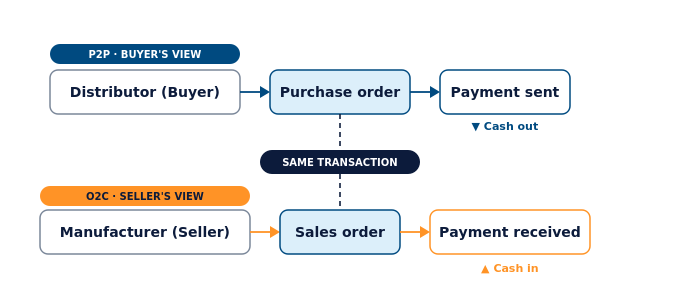
Procure-to-pay and order-to-cash are two connected business cycles that show how cash moves into and out of an organization. P2P connects purchasing, receiving, accounts payable, and supplier payments. O2C connects sales orders, fulfillment, invoicing, accounts receivable, and customer payments.
Understanding the differences between P2P and O2C helps finance and operations leaders assign process ownership, identify bottlenecks, evaluate ERP requirements, and improve working-capital visibility. This article compares the two cycles and explains how connected ERP data can reduce manual work across both.
Principales conclusiones:
- P2P manages purchases, supplier obligations, and cash outflows; O2C manages customer orders, receivables, and cash inflows.
- A transaction may be part of the buyer’s P2P process and the seller’s O2C process.
- P2P usually involves procurement, receiving, AP, and finance; O2C involves sales, fulfillment, AR, and finance.
- DPO helps measure P2P payment timing, while DSO helps measure O2C collection timing.
- An integrated ERP system connects both cycles through shared records, automated workflows, and current financial reporting.
How Do Procure-to-Pay and Order-to-Cash Work Together?
P2P and O2C work together by connecting expected cash outflows with expected cash inflows. P2P data shows upcoming purchasing commitments, supplier invoices, and payment obligations. O2C data shows open customer orders, outstanding invoices, expected collections, and received payments.
Evaluating these processes together gives finance leaders a more complete view of liquidity and working capital. When the cycles operate in disconnected systems or spreadsheets, cash forecasting depends on manually combining AP, AR, purchasing, sales, and inventory information.
Connecting that data through ERP helps finance teams identify timing gaps, anticipate cash requirements, and investigate process bottlenecks earlier.
Cómo el proceso «Procure-to-Pay» controla el gasto y el riesgo de los proveedores
Procure-to-pay is the process a business uses to request, purchase, receive, verify, and pay for goods and services. It connects procurement, receiving, accounts payable, and finance. The process generally begins when the organization identifies a purchasing need and ends when the supplier payment is issued, recorded, and reconciled.
Depending on the organization, supplier sourcing and contract negotiation may occur before the P2P cycle. These activities are generally part of the broader source-to-pay process.
What Are the Steps in the Procure-to-Pay Process?
The Procure-to-Pay Process
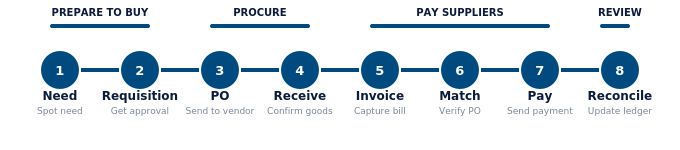
A typical procure-to-pay cycle includes the following steps:
- Identify a purchasing need. An employee, department, or inventory-planning process identifies a requirement for goods or services.
- Create and approve a purchase requisition. The request is reviewed against budgets, purchasing policies, and authorization limits.
- Create and issue a purchase order. An approved requisition is converted into a purchase order and sent to the supplier.
- Receive the goods or services. The organization records the quantity and condition of the items received or confirms that the service was completed.
- Capture the supplier invoice. Accounts payable records the invoice and verifies the supplier, amount, terms, taxes, and other details.
- Match and approve the invoice. The invoice may be compared with the purchase order and receiving record through two-way or three-way matching.
- Issue payment. The organization pays the approved invoice according to its payment terms and cash-management policies.
- Reconcile and report the transaction. Finance records the payment, updates the general ledger, and monitors purchasing and AP performance.
Si se analiza de principio a fin, el proceso P2P pasa por cuatro fases generales: preparación de la compra, adquisición de bienes y servicios, pago a los proveedores y revisión del rendimiento para mejorar el ciclo. Los responsables deben asignar claramente las responsabilidades y los controles en cada etapa.
Entre los problemas habituales del P2P se incluyen:
- Manual approval routing that delays purchase orders and payments.
- Mismatched invoices that create exceptions and rework in accounts payable.
- Weak purchasing controls that allow spend outside approved suppliers or processes.
- Duplicate data entry between procurement, receiving, inventory, and finance systems.
- Limited visibility into open commitments and outstanding liabilities.
Connecting purchasing, receiving, inventory, AP, and reporting data in an ERP system can reduce duplicate entry and improve control across the P2P cycle. Acumatica supports electronic vendor invoice capture, while paper invoices can be captured through optical character recognition. The system identifies information such as the vendor, terms, currency, line items, and invoice amount, reducing the need to enter these details manually.
What Is the Order-to-Cash Process?
Order-to-cash is the process a business uses to receive and fulfill customer orders, invoice customers, collect payment, and apply the received cash. It connects sales, order management, inventory or service delivery, accounts receivable, payments, and finance. The process generally begins when a customer places an order and ends when the payment is applied and the receivable is reconciled.
What Are the Steps in the Order-to-Cash Process?
The Order-to-Cash Process
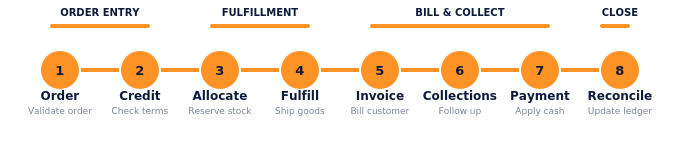
A typical order-to-cash cycle includes the following steps:
- Receive and validate the customer order. The business confirms the products or services, quantities, prices, delivery requirements, and payment terms.
- Review customer credit and terms. The organization verifies the customer’s credit status and determines whether the order requires additional approval.
- Allocate inventory or schedule delivery. Available inventory is reserved, production is planned, or services are scheduled.
- Fulfill the order. Products are picked, packed, and shipped, or the agreed services are delivered.
- Generate the customer invoice. The business creates an accurate invoice based on the order and fulfillment information.
- Manage collections. Accounts receivable monitors open invoices, communicates with customers, and resolves disputes.
- Receive and apply payment. Customer payments are matched with the correct invoices and recorded in the accounting system.
- Reconcile and report the transaction. Finance updates the general ledger and monitors receivables, collections, and cash-flow performance.
Cuando los procesos de gestión de pedidos, pagos y cuentas por cobrar (AR) están desconectados, se acumulan retrasos en cada punto de traspaso. Un pedido de venta que no pasa automáticamente a la fase de cumplimiento y facturación genera lagunas que ralentizan el cobro y aumentan el riesgo de errores de facturación. Conectar estos pasos en un sistema compartido favorece una ejecución más coherente del proceso O2C. El software de gestión de pedidos de Acumatica incluye sugerencias de sustitución de artículos, ventas adicionales y ventas cruzadas asistidas por IA dentro de la gestión de pedidos de venta. Esto ayuda a los equipos de ventas a presentar opciones complementarias relevantes sin necesidad de búsquedas manuales. Para las empresas con múltiples entidades o que operan a nivel internacional, la coherencia de los procesos O2C entre las distintas ubicaciones y entidades jurídicas es especialmente importante para obtener informes precisos y consolidados.
What Is the Difference Between Procure-to-Pay and Order-to-Cash?
The main difference between procure-to-pay and order-to-cash is the direction and purpose of the transaction. P2P manages purchases, supplier obligations, and cash leaving the business. O2C manages customer orders, receivables, and cash entering the business. The processes also involve different owners, documents, risks, controls, and ERP capabilities.
Procure-to-Pay vs. Order-to-Cash Comparison
La tabla siguiente resume las diferencias estructurales más importantes entre P2P y O2C. Tener claras estas distinciones ayuda a los responsables a asignar responsabilidades, evaluar los requisitos del ERP y priorizar las mejoras en los procesos.
| Comparison Area | De la adquisición al pago (P2P) | Del pedido al cobro (O2C) |
|---|---|---|
|
Primary Purpose |
Purchase goods and services and pay suppliers accurately | Fulfill customer orders, invoice customers, and collect payment |
|
Desencadenante del proceso |
Internal purchasing need, requisition, or inventory-replenishment signal | Customer purchase order, online order, contract, or sales order |
|
Starting Point |
Purchasing need or approved requisition | Accepted customer order |
|
Ending Point |
Supplier payment is recorded and reconciled | Customer payment is applied and reconciled |
|
Primary Relationship |
Supplier-facing from the buyer’s perspective | Customer-facing from the seller’s perspective |
|
Equipos participantes |
Procurement, receiving, accounts payable, and finance | Sales, order management, fulfillment, accounts receivable, and finance |
|
Documentos fundamentales |
Requisitions, purchase orders, receipts, supplier invoices, and payment records | Sales orders, fulfillment records, customer invoices, collection records, and cash receipts |
|
Financial Direction |
Cash outflow and accounts payable | Cash inflow and accounts receivable |
|
Principales riesgos |
Unauthorized spending, invoice mismatches, duplicate payments, fraud, and delayed approvals | Credit risk, billing errors, fulfillment delays, disputes, late payments, and inaccurate cash application |
|
Core ERP Capabilities |
Requisition management, purchasing, receiving, invoice capture, AP, and supplier payments | Sales order management, inventory and fulfillment, invoicing, AR, collections, and customer payments |
|
Common KPIs |
PO cycle time, invoice exception rate, on-time payment rate, and DPO | Order-fulfillment time, DSO, overdue receivables, collection effectiveness, and cash-application accuracy |
How Do P2P and O2C Affect Working Capital?
P2P affects working capital by determining when supplier obligations are created and paid. One related metric is days payable outstanding (DPO), which measures the average time a company takes to pay suppliers. O2C affects working capital by determining how quickly customer orders become collected cash. Days sales outstanding (DSO) measures the average time required to collect payment after a sale.
The Working Capital Gap: DPO vs. DSO
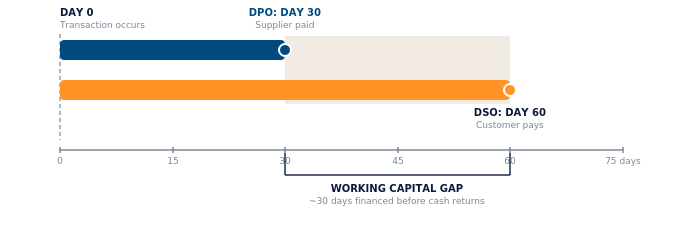
Example only: actual DPO and DSO vary by industry and company
Managing DPO and DSO together helps finance leaders understand the timing difference between cash entering and leaving the business. However, the goal is not simply to maximize DPO or minimize DSO. Companies must balance liquidity with contractual requirements, supplier relationships, customer experience, available discounts, and credit risk.
When AP and AR information resides in separate systems, finance teams may need to reconcile multiple reports before evaluating working capital. An integrated ERP system can provide a more current view of open purchase commitments, supplier invoices, customer receivables, and expected payments.
Cómo integra el ERP los datos de cuentas por pagar, cuentas por cobrar y flujo de caja
ERP connects P2P and O2C by maintaining purchasing, receiving, inventory, sales, fulfillment, AP, AR, payments, and general ledger information in a shared system. Transactions can move between departments without being recreated manually, while dashboards and reports provide a consolidated view of supplier obligations, customer receivables, and cash activity.
Cómo los datos compartidos reducen los retrasos, los errores, las repeticiones de trabajo y los costes
Los equipos financieros que aún tienen que volver a introducir manualmente los datos entre los sistemas de compras, recepción, finanzas y gestión de pedidos se enfrentan a excepciones evitables en cada traspaso. Volver a introducir las facturas de los proveedores en la contabilidad de acreedores (AP) después de que ya se hayan registrado en el sistema de compras genera registros duplicados. Los datos de los pedidos de venta que no fluyen automáticamente hacia la facturación requieren una intervención manual antes de que se pueda realizar la facturación. La conciliación a tres bandas (comparar una factura con la orden de compra de origen y el registro de recepción) es un control fundamental del proceso P2P que resulta mucho más manejable cuando los tres documentos se encuentran en el mismo sistema. Las funciones de gestión de órdenes de compra que vinculan directamente los pedidos de venta con las órdenes de compra, admiten órdenes de compra marco y envíos directos del proveedor al cliente, asignan automáticamente los artículos recibidos y derivan las excepciones al responsable de aprobación adecuado, reducen el esfuerzo manual que genera cuellos de botella en ambos ciclos. Las aprobaciones automatizadas preservan el control interno al tiempo que eliminan los retrasos derivados de la búsqueda de firmas por correo electrónico.
Visibilidad en tiempo real del efectivo y control operativo
Los responsables necesitan una visión actualizada de las órdenes de compra pendientes, las facturas de proveedores, las facturas de clientes, el estado de los cobros y los plazos de pago para tomar decisiones fundamentadas. Los paneles de control y las herramientas de generación de informes sirven como instrumentos prácticos de apoyo a la toma de decisiones para los equipos de finanzas, operaciones y dirección. A medida que las empresas crecen, el aumento del número de transacciones, sedes, entidades y usuarios hace que el seguimiento basado en hojas de cálculo sea cada vez más difícil de mantener con precisión. Las empresas con múltiples sedes y entidades se enfrentan a una complejidad adicional. La visibilidad consolidada de la tesorería entre las distintas entidades jurídicas requiere que los datos estén estructurados de forma coherente y se actualicen en tiempo real. Las soluciones ERP que presentan estos datos a través de paneles de control configurables ofrecen a los responsables financieros una visión actualizada del capital circulante, el pasivo y las cuentas por cobrar, sin necesidad de realizar búsquedas manuales.
¿Qué funciones de P2P y O2C son las más importantes en un sistema ERP?
Las funciones de P2P y O2C más importantes en un sistema ERP dependen de dónde se produzcan mayores dificultades en la empresa: control de compras, tramitación de facturas, gestión de pedidos, cobros o previsión de tesorería. El objetivo es identificar qué capacidades resuelven las carencias específicas que provocan problemas de tesorería, control u operativos. No existe una lista única de funciones que se aplique a todas las empresas, pero hay ciertas capacidades que mejoran sistemáticamente el rendimiento tanto de P2P como de O2C. Entre los criterios clave de evaluación se incluyen:
| ERP Capability | How It Supports P2P | How It Supports O2C |
|---|---|---|
|
Automatización del flujo de trabajo |
Routes requisitions, POs, invoices, and payments for approval | Routes orders, credit exceptions, adjustments, and refunds for review |
|
Document Matching |
Compares supplier invoices with purchase orders and receipts | Connects customer invoices with orders, shipments, and payments |
|
Gestión de pedidos e inventarios |
Provides visibility into purchasing requirements and received inventory | Supports product availability, allocation, fulfillment, and shipment tracking |
|
AP and AR Management |
Tracks supplier invoices, due dates, and payment status | Tracks customer balances, aging, collections, and payment status |
|
Integrated Payments |
Supports controlled supplier-payment processing | Supports customer-payment collection and cash application |
|
Dashboards and Analytics |
Monitors open POs, exceptions, liabilities, and DPO | Monitors open orders, receivables, collections, and DSO |
|
Permissions and Audit Trails |
Documents purchasing and payment approvals | Documents credit, billing, adjustment, and collection activity |
|
Integraciones |
Connects suppliers, banks, logistics providers, and purchasing systems | Connects commerce, CRM, banks, logistics, and customer-payment systems |
Dar prioridad a la automatización de los flujos de trabajo, las aprobaciones y las reglas de correspondencia
Automated approval workflows are foundational to both P2P and O2C control. P2P requires approval routing for requisitions, purchase orders, invoices, and payment steps, while O2C requires approval and review workflows for sales orders, credit decisions, and adjustments. In Acumatica, embedded Requisition Management lets employees submit stock and non-stock requests and managers approve them from mobile devices, with requests validated against defined budgets before they convert to a purchase order.
La conciliación a tres bandas también reduce el riesgo de facturación excesiva y de pagos duplicados, y el enrutamiento de excepciones garantiza que las discrepancias se remitan a la persona adecuada para su resolución, en lugar de quedarse estancadas en una cola.
El objetivo de la automatización en estos contextos es reducir el esfuerzo manual, al tiempo que se mantienen los mecanismos de gobernanza y los controles internos en los que se basan los equipos de finanzas y auditoría. Consulte el artículo de Acumatica sobre el proceso «procure-to-pay» en el sector de la distribución para ver ejemplos prácticos de cómo se aplican estos controles en entornos de gran volumen.
Presta especial atención a los informes, las trazas de auditoría, los paneles de control y las integraciones
Reporting and audit trails matter to finance leaders because they support risk management, compliance, and month-end close accuracy. An ERP system that maintains a complete, time-stamped record of who approved what, when, and at what amount simplifies internal reviews and external audits. Dashboards that surface aging balances, open POs, outstanding customer invoices, and payment status give operations and finance teams the information they need to act before issues escalate. Integrations with commerce platforms, integrated payment processing systems, bank feeds, and inventory management tools ensure that P2P and O2C data stays current across all connected systems.
¿Cuándo deberían las empresas en crecimiento mejorar sus ciclos P2P y O2C?
Las pymes en expansión no siempre tienen que reformar los procesos P2P y O2C a la vez. El punto de partida adecuado depende de qué flujo de trabajo esté teniendo un mayor impacto en la tesorería, el control o la atención al cliente. Entre los indicios habituales de que hay que prestar atención al proceso P2P se incluyen:
| Business signal | Improve P2P first | Improve O2C first | Consider both |
|---|---|---|---|
| Purchase approvals regularly delay orders | ✓ | ||
| Invoice exceptions require extensive AP work | ✓ | ||
| Supplier payments are late or duplicated | ✓ | ||
| Open purchasing commitments are difficult to track | ✓ | ||
| Billing errors frequently delay customer payments | ✓ | ||
| DSO and overdue receivables are increasing | ✓ | ||
| Collection and cash-application work is heavily manual | ✓ | ||
| Order and fulfillment information is disconnected | ✓ | ||
| Cash forecasting requires separate AP and AR spreadsheets | ✓ | ||
| The company operates across multiple entities, locations, or currencies | ✓ | ||
| Growth is increasing transaction volume across departments | ✓ |
Cómo pueden los equipos financieros reducir el trabajo manual en ambos ciclos
Los equipos financieros pueden reducir el trabajo manual en los ciclos «de la adquisición al pago» y «del pedido al cobro» llevando a cabo mejoras específicas y estratégicas, en lugar de reformarlo todo de una sola vez. Algunos puntos de partida prácticos son:
- Estandarizar las normas de autorización para las compras, las facturas y los pedidos de venta, de modo que las políticas se apliquen de forma coherente y no caso por caso.
- Limpieza de los datos maestros de proveedores y clientes para reducir las discrepancias, los registros duplicados y las correcciones manuales.
- Automatizar la captura de facturas mediante herramientas que reconozcan el proveedor, la moneda, las partidas y los importes sin necesidad de introducir los datos manualmente.
- Conectar los flujos de trabajo de pedidos y pagos para que los pedidos de venta pasen directamente a la facturación y al cobro sin necesidad de traspasos manuales.
- Supervisar los indicadores clave de rendimiento (KPI) comunes a ambos ciclos para identificar los cuellos de botella antes de que afecten a la tesorería. Los KPI que deben supervisarse en los procesos P2P y O2C incluyen:
- Duración del ciclo de pedido.
- Índice de excepciones en las facturas.
- Índice de pagos puntuales.
- DSO (días de cobro).
- DPO (días de pago pendiente).
- Saldo de cuentas por pagar y por cobrar.
- Exactitud en la contabilización de los ingresos en efectivo.
- Tiempo de ciclo de tramitación de pedidos.
El software ERP en la nube de Acumatica y su módulo de cuentas por pagar están diseñados para facilitar estas mejoras en las pymes, conectando los datos, los flujos de trabajo y los informes que los equipos financieros necesitan para operar con mayor coherencia y control.
Conclusion: Connect P2P and O2C for Better Cash Visibility
Procure-to-pay and order-to-cash manage opposite but connected sides of business activity. P2P controls how the organization purchases goods and services and pays suppliers. O2C controls how it fulfills customer orders, generates invoices, collects payments, and applies cash.
Improving either cycle can reduce manual work and process delays, but connecting both provides a more complete view of working capital. Shared ERP data helps finance and operations teams monitor purchasing commitments, supplier obligations, customer receivables, order status, and cash activity without manually reconciling information from separate systems.
Acumatica connects financial management with purchasing, inventory, order management, fulfillment, reporting, and integrated payments. Explore how ERP for accounts payable and receivable can support more consistent processes and better cash-flow visibility.
Nota sobre el asesoramiento profesional: los requisitos financieros, contables, fiscales y de cumplimiento normativo varían según la organización. El diseño de los procesos P2P y O2C, los controles internos, las definiciones de los indicadores clave de rendimiento (KPI) y las prácticas de presentación de informes deben adaptarse a las políticas contables de su empresa y revisarse con profesionales cualificados en contabilidad, auditoría, fiscalidad y cumplimiento normativo antes de que se aprueben los cambios en los procesos o los sistemas. Esto es especialmente importante para las empresas con múltiples entidades, múltiples sedes o que operan a nivel internacional.
Preguntas frecuentes
¿Cuál es la diferencia entre «procure-to-pay» y «order-to-cash»?
Procure-to-pay manages how a business purchases goods and services and pays suppliers, making it primarily a cash-outflow and accounts-payable process. Order-to-cash manages how a business receives and fulfills customer orders, issues invoices, collects payments, and applies cash, making it primarily a cash-inflow and accounts-receivable process.
Are procure-to-pay and order-to-cash opposite processes?
Yes. P2P represents the purchasing and payment side of a commercial transaction, while O2C represents the sales and collection side. The same transaction may be part of the buyer’s P2P process and the seller’s O2C process.
What are the main steps in procure-to-pay?
The main P2P steps are identifying a need, approving a requisition, issuing a purchase order, receiving the goods or services, capturing the supplier invoice, matching and approving the invoice, issuing payment, and reconciling the transaction.
What are the main steps in order-to-cash?
The main O2C steps are receiving an order, validating customer credit and terms, allocating inventory or scheduling delivery, fulfilling the order, invoicing the customer, managing collections, applying payment, and reconciling the receivable.
Who owns the P2P and O2C processes?
Procurement, receiving, accounts payable, and finance usually share responsibility for P2P. Sales, order management, fulfillment, accounts receivable, and finance generally share responsibility for O2C. Exact ownership depends on the organization’s structure and processes.
How do P2P and O2C work together?
P2P provides information about purchasing commitments, supplier invoices, and expected cash outflows. O2C provides information about customer orders, receivables, and expected cash inflows. Reviewing both cycles together helps finance teams improve cash forecasting and working-capital decisions.
Is procure-to-pay the same as source-to-pay?
No. Procure-to-pay generally covers the transactional process from a purchasing request through supplier payment. Source-to-pay is broader and may also include supplier discovery, strategic sourcing, contract negotiation, and supplier management.
Should a company improve P2P or O2C first?
A company should begin with the process creating the greatest financial or operational impact. Late supplier payments, invoice exceptions, and weak purchasing controls indicate that P2P may need attention. Slow collections, billing disputes, fulfillment delays, and poor AR visibility indicate that O2C may be the higher priority.


